
说出你的故事
Return of delicate aquatic plant signals Chinese lake's revival_我的网站

一 |

Seventeen members of a cross-border human trafficking ring involved in abducting Chinese actor Wang Xing to Myawaddy have been indicted on charges including abducting and trafficking people, illegal detention, robbery and kidnapping, and forcing people to engage in telecom fraud, according to CCTV News on Wednesday.
The indictment was filed by the Second Branch of the People's Procuratorate of Shanghai Municipality after a review in accordance with China's laws. The suspects were prosecuted at the Shanghai No.2 Intermediate People's Court.
According to the procuratorate, the criminal group had been operating in the Myawaddy region of Myanmar. Using overseas employment opportunities as bait, the group lured Chinese citizens, including Wang, abroad and trafficked them. Victims were then forcibly transported by armed personnel to Myawaddy, where they were robbed, beaten and illegally detained. Some female victims were subjected to sexual assault and forced prostitution, while others were sold to scam compounds in Myanmar and forced to engage in telecom fraud activities.
The case involving Chinese actor Wang Xing, who was trafficked to a telecom fraud compound in Myanmar's Myawaddy region, previously attracted widespread public attention in China and Thailand.
According to a timeline compiled by CCTV News, on December 29, 2024, Wang saw a casting notice in a WeChat group seeking actors for a film project in Bangkok. He contacted a person claiming to be an assistant director through WeChat and discussed the filming opportunity.
On January 3, 2025, after arriving at Bangkok airport, Wang was picked up in a vehicle arranged by the self-proclaimed assistant director. Wang was later taken across the Thailand-Myanmar border area into a compound in Myawaddy, Myanmar. He was subsequently transferred among several telecom fraud compounds.
On the evening of January 5, social media post revealed that actor Wang had gone missing near the Thailand-Myanmar border, sparking widespread attention in both countries.
On January 6, the Chinese Consulate General in Chiang Mai said it was in close communication with Thai authorities and Wang's family, providing necessary assistance while making every effort to locate him.
On January 7, the consulate general said it had learned from Thailand's Tak Immigration Office that Wang had been found and that relevant procedures, including questioning, were underway. The same day, Thai police received a report from the deputy commander of the Border Guard Force (BGF) in Myanmar confirming that Wang had been located.
On January 8, Thai police confirmed that Wang had been deceived into traveling abroad for a casting opportunity and was taken through Thailand to a neighboring country, where he discovered he had been deceived.
Authorities clarified that he had not suffered physical injuries, dismissing online rumors that he had been injured in the leg. The Royal Thai National Police chief inspector-general told Thai media that preliminary investigations confirmed Wang was a victim of human trafficking.
Wang returned to China, landing at Shanghai Pudong International Airport three days later on January 11.
On January 17, China's Ministry of Public Security announced that it was making every effort to rescue Chinese citizens who had gone missing and become trapped along the Thailand-Myanmar border, while launching investigations into related cases.
On January 26, the ministry said a key suspect in Wang's case, the "assistant director" who had been in contact with Wang, had been apprehended and returned to China on the night of January 25.
On February 20, the Ministry of Public Security announced that 10 key suspects linked to cases involving Wang and other Chinese citizens who had been deceived into traveling abroad, detained illegally and trapped in telecom fraud compounds had been arrested by Thai police and successfully transferred back to China by Chinese police on February 15.
Global Times
。

二 |
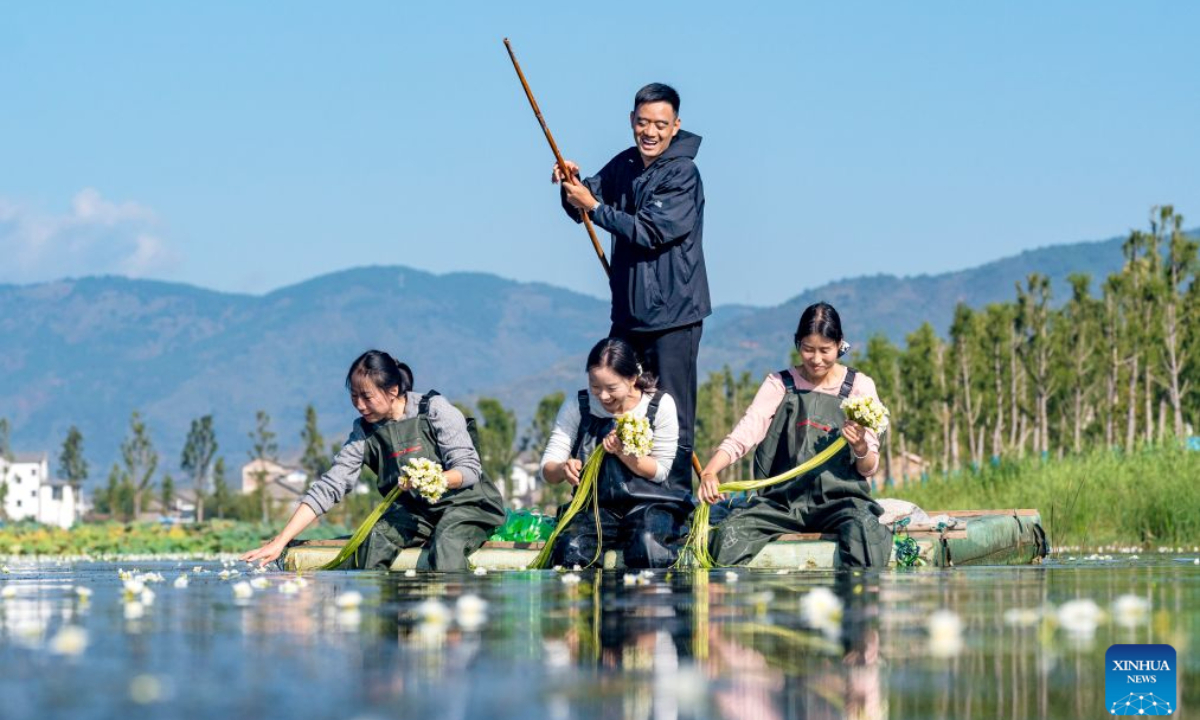
The delicate blossom seen floating there is Ottelia acuminata, an aquatic plant endemic to China, which is known to have extremely strict water quality requirements. It demands high water transparency, cleanliness and calcium content, and survives only in unpolluted waters, serving as a reliable natural indicator of aquatic ecological health.
Its large-scale revival vividly testifies to Erhai Lake's remarkable ecological restoration achievements.
China's Ecological and Environmental Code, enacted on Saturday, stipulates nationwide protection and restoration of river and lake ecosystems, providing solid legal support for systematic water ecological governance across the country.
As China advances its Beautiful China initiative, this code is expected to strengthen rule-of-law guarantees for ecological protection and provide fresh impetus for the country's green and low-carbon transition.
In the early 1990s, agricultural pollution worsened Erhai Lake's water quality, causing frequent blue-green algae outbreaks. A severe algae bloom hit the lake in 1996, leaving the water turbid and smelly. As the environment degraded, Ottelia acuminata nearly disappeared from the lake.
Thanks to years of targeted ecological protection and restoration efforts, the lake's water quality has improved steadily, maintaining an excellent Grade II standard from January to June 2026, and creating favorable conditions for the return of Ottelia acuminata.
Official data show that the plant's coverage on Erhai Lake has surged from 90,000 square meters in 2021 to 950,000 square meters in 2026, marking a remarkable ecological recovery.
The improved water environment has also brought tangible economic benefits, turning the lake's ecological advantages into a sustainable industry. From lake ecology to farm cultivation and consumer products, Ottelia acuminata's dual ecological and economic value has been fully realized.
In 2018, environmental worker Zhong Lan noticed the edible plant's great potential for water purification and industrial development. With support from local authorities and Shanghai Jiao Tong University in eastern China, she started a company and built a professional research base in 2024, developing standardized planting techniques that enable high-yield, repeated harvests and offering jobs for local villagers.
Villager Li Xinyuan, who quit Ottelia acuminata cultivation years ago due to low profits, resumed planting in 2023 and earns a stable monthly salary of 4,500 yuan (about 663 U.S. dollars) at the base.
His fellow villager Du Hongquan earned over 100,000 yuan last year from growing the plant and has more than doubled his planting area this year. "The base takes full charge of sales, so we can plant without any worries," Du said.
Eryuan County, the source of Erhai Lake, now has more than 200 hectares of Ottelia acuminata plantation area, creating numerous jobs yearly. The plant has been developed into a diverse range of products like tea, plant-based coffee and cookies.
"I used to think it was exclusive to Yunnan, but I can try it elsewhere too," said a tourist surnamed Ai after tasting the plant at a hotpot restaurant in Hangzhou, east China's Zhejiang Province.
The beautiful lakeside scenery at Erhai has also boosted local tourism. In 2025, Dali received over 120 million tourist visits, attracting visitors to enjoy lake views and experience local Bai ethnic culture, with 407,000 long-term visitors.
Last month, the State Council issued a plan for building a Beautiful China during the 15th Five-Year Plan period (2026-2030), setting out the overall requirements, targets, key tasks and major projects for comprehensively advancing this initiative.
According to the plan, China will achieve overall improvement in ecological and environmental quality and make significant progress toward building a Beautiful China by 2030, with green production and lifestyles largely established and the carbon peaking target reached on schedule.
。
Current article:http://tuzq3a.taokenlaichunlei.bond/p12/20260826/4157.html
Published on:20:14:34
回家的诱惑_Random reading
- 08-24诺里斯赢了,但赛道上更快的是法拉利
- 08-26Scientists Explain Why Taxing Mental Work Wears You Out
- 08-23外媒:乌克兰外长与乌“第一夫人”同访塞尔维亚,武契奇宣布塞大使将重返基辅
- 08-22美财长再炒作所谓中国“产能过剩论” 反遭质问
- 08-26基督教金属乐队 Demon Hunter 起诉 Netflix,指控《KPop Demon Hunters》导致粉丝买错演出门票
- 08-20红板科技:上半年净利润5.39亿元 同比增长124.74%
- 08-26今天出伏秋凉还早 鹭岛今明两天雨势猛
- 08-23拼多多如何优化直通车投产比
- 08-26医疗保障法草案将三审 拟细化异地就医医药费用结算要求
- 08-21国庆假期天气预报出炉!10月1日气温将下降10~12℃

花木兰传奇_Active users
- Tropical Storm Norma could become Category 3 hurricane before hitting Mexican resorts
- Datong's agricultural trade surpasses 250 mln yuan in H1
- 埃隆·马斯克的Twitter交易可能会打击杠杆收购市场
- 罗马诺:曼城正与奥赖利谈续约,新合同可能会涨薪
- 三部门:加强新能源汽车安全管理工作 绝不能偷工减料
- 台湾加权股价指数收涨0.91%
- 打了80场!吉莱斯皮谈全明星后投篮下滑:出场时间太多是原因之一
- Off-duty pilot charged with 83 counts of attempted murder for allegedly trying to shut off engines on Alaska Airlines flight
- 情暖八一 微光送爱——九江、景德镇两地开展“微光行动”慰问退役军人
- 外交部:美方尚未就攻击西工大作实质性回应
- 聚石化学:终止2024年度向特定对象发行A股股票事项
- “旅客买票占座放零食”应如何处理?专家解读
- 外交部:国际社会对香港特区优势和发展前景充满信任_毛宁_自由度
- 如何应对低温、雨雪、冰冻天气?
- Israel reaches historic agreement with Lebanon
- 政府今年将节省开支大举减税,有多少公务员会被裁?
- 2年3000万嫌少!认为自己不输风雪哥,曾连续3场40+,24岁没人要
- 特斯拉最快将于11月底向欧洲客户交付Model S Plaid
偷心俏冤家_Hottest this week
- 说出你的故事 copyright
- Some of the content comes from the Internet. If you have any offence, please raise it.